Cluely vs AI Prep vs Mock Interviews: What to Use in 2026
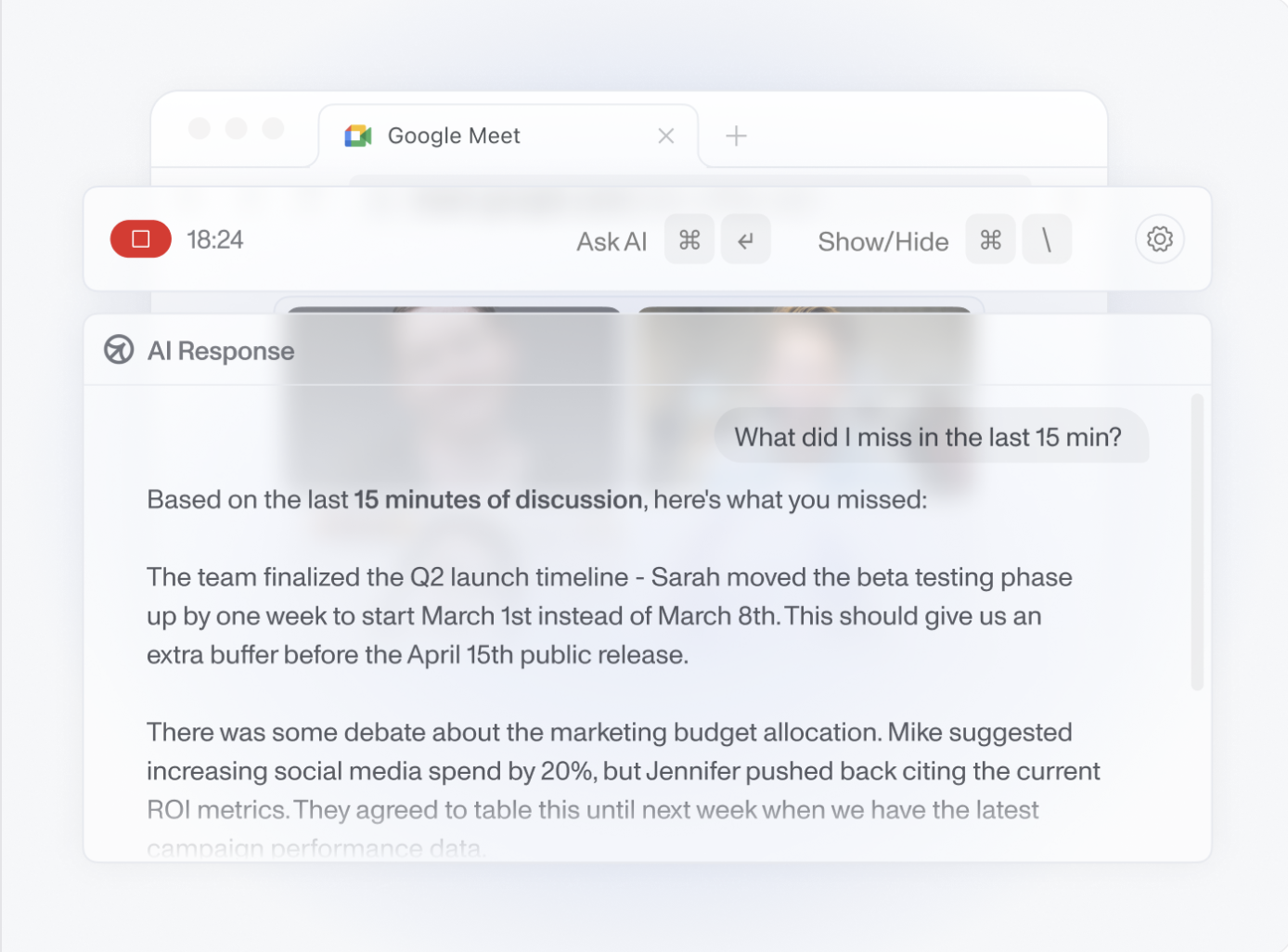
AI-assisted preparation wins for building skill cheaply before the interview, and human mock interviews win for realistic feedback under pressure. A live AI copilot during the interview (the use case Cluely became famous for) loses on every criterion that matters to your career, because the companies you want to join have said in writing that it can get you disqualified. We compared the three approaches on five criteria: detection and disqualification risk, policy compliance, skill you keep on the job, cost, and realism of feedback, using public company policies, news reporting and published pricing as of October 2026. Below you get a verdict table, a criterion-by-criterion breakdown, and a short decision guide.
Quick verdict
| Criterion | Live AI copilot (e.g. Cluely) | AI-assisted prep before the interview | Human mock interviews |
|---|---|---|---|
| Detection and disqualification risk | High: banned in live rounds at Amazon and Anthropic | None: explicitly encouraged by Anthropic | None |
| Policy compliance and ethics | Violates most stated policies unless AI is explicitly allowed | Compliant | Compliant |
| Skill retained on the job | Low: the tool does the thinking | Medium to high, if you do the work yourself | High: you solve under real pressure |
| Cost | $19.99 to $149.99 per month (Cluely plans) | Free to about $20 per month | Roughly $225 to $339 per expert session on one major platform |
| Realism of feedback | None: no one grades you | Medium: useful, but no real interviewer judgment | High: a human interviewer scores you |
| Best for | Not recommended for interviews | Daily practice, explanations, drafting stories | Final rehearsal, calibration, nerves |
How we compared them
We scored each option against the same five criteria and the same scenario: a software engineer preparing for a remote technical loop at a large tech company in 2026. For each criterion we looked for at least one public, verifiable source per option:
- Detection and policy: published candidate guidelines and reporting on Amazon, Google, Anthropic and Meta.
- Skill retained: peer-reviewed or preprint research on how AI assistance affects learning and recall.
- Cost: list prices on vendor pricing pages or recent pricing reviews.
- Feedback realism: who evaluates you, and whether that evaluation resembles a real hiring decision.
We did not run a private experiment or survey. Every number below links to its source, and every criterion names a winner.
Live copilot vs AI prep vs mock interviews for detection risk and policy compliance
Winner: AI-assisted preparation, which at least one major AI employer explicitly encourages. Human mock interviews are equally safe. A live copilot is the only option with a real chance of ending your candidacy.
What companies have said about live AI use
Amazon's internal guidance for candidates, reported in March 2025, reads: "please do not use GenAI tools during your interview unless explicitly permitted," and warns that failure to follow it "may result in disqualification from the recruitment process" (ITPro, citing Business Insider). The same reporting lists signs interviewers were told to watch for: typing while being asked a question, reading rather than responding naturally, and wandering eyes.
Anthropic's candidate AI guidance splits the process by stage. For interview prep it says: "Use Claude to research Anthropic, practice your answers, and prepare questions for us." For live interviews it says "This is all you" and allows no AI assistance unless Anthropic indicates otherwise. Take-home assessments get the same rule.
Google CEO Sundar Pichai told employees at a February 2025 town hall that it is "worth thinking about some fraction of the interviews being in person," and later said Google would "introduce at least one round of in-person interviews for people just to make sure the fundamentals are there" (HRD America, August 2025). An in-person round makes a hidden screen overlay useless, and it means a candidate who leaned on one in earlier rounds has to perform alone at the onsite.
Employers are worried for a reason. In a Gartner survey of 3,000 job candidates reported in July 2025, 6% admitted to interview fraud, such as having someone else pose as them, and Gartner predicted that by 2028, 1 in 4 candidate profiles worldwide could be fake.
The Cluely story, briefly
Cluely grew out of Interview Coder, a tool its co-founders built to show AI-generated coding solutions during technical interviews. Co-founder Roy Lee said he used it to land an Amazon internship and published a recording of the interview, after which Amazon complained to Columbia University and Lee and co-founder Neel Shanmugam were suspended (TechCrunch, April 2025). The company raised $5.3 million in seed funding with a "cheat on everything" pitch, then by November 2025 repositioned itself toward being "the best AI note taker" for meetings (TechCrunch, November 2025). In fairness to Cluely, its current product is a general meeting assistant, and its pricing page describes uses like meetings and sales calls. The interview risk comes from how a candidate chooses to use any hidden copilot, not from the brand.
The one exception: AI the interviewer gives you
Some companies now build AI into the interview on purpose. Meta began rolling out an "AI-enabled coding" round in October 2025 in which candidates can use built-in assistants, a format Meta described as "more representative of the developer environment that our future employees will work in" and one that "makes LLM-based cheating less effective" (Hello Interview). Using the tools the interviewer provides is allowed. Using a hidden one is not.
Live copilot vs AI prep vs mock interviews for skill retained on the job
Winner: human mock interviews, with AI-assisted prep a close second when you do the thinking yourself. A live copilot leaves you with the job but without the skill that got tested.
The clearest public evidence on this comes from the MIT Media Lab study "Your Brain on ChatGPT", in which 54 participants wrote essays with an LLM, a search engine, or no tools. The authors report that LLM users "struggled to accurately quote their own work" and reported lower ownership of it. It is an essay study, not a coding study, but the mechanism carries over: if a model produces the answer, you do not encode it.
AI-assisted prep can go either way. Asking a model to explain why a sliding window works, then writing the solution yourself, builds skill. Pasting the problem and reading the answer does not. Human mock interviews force retrieval under time pressure with someone watching, which is closest to the conditions you will face in the real loop and in on-call incidents later.
Example of skill-building AI prep (illustrative):
Prompt: "I solved 'merge intervals' in O(n log n). Do not give me code.
Ask me three follow-up questions an interviewer might ask, one at a time,
and tell me which part of my explanation was vague."
Live copilot vs AI prep vs mock interviews for cost and realism of feedback
Cost
Winner: AI-assisted preparation. It is the cheapest option by a wide margin, and many candidates already pay for a chatbot subscription.
- Live copilot: Cluely's pricing page lists a free Starter plan, Pro at $19.99 per month, and "Pro + Undetectability" at $149.99 per month, the tier described as "completely hidden to meeting screen sharing software." The real cost is the downside risk: a rejection or do-not-hire flag at a company you wanted.
- AI-assisted prep: free tiers exist, and OpenAI launched ChatGPT Plus at $20 per month. Anthropic tells candidates to use Claude for prep, so the tool you already have is enough.
- Human mock interviews: a March 2026 pricing review of interviewing.io puts expert sessions at around $225 and company-branded sessions closer to $339. That is the most expensive per hour, which is why most candidates use a handful of sessions rather than dozens.
Realism of feedback
Winner: human mock interviews. Only a human interviewer can give you the signal a hiring committee will act on: whether they would hire you.
A live copilot gives no feedback at all. It produces answers, but nobody tells you whether your communication, pacing or trade-off reasoning would pass. AI prep tools can grade code and critique a STAR story, but they tend to be agreeable and they do not experience your silence, your rambling or your nerves. A human interviewer does, and that is what the real rubric rewards. Amazon's interviewer guidance, for example, flags candidates who appear to read rather than respond naturally (ITPro), a delivery problem a model reviewing your transcript will rarely catch.
Example scorecard note a human interviewer might write (illustrative): "Reached a working solution in 30 minutes. Did not state complexity until asked. Jumped to code before confirming input constraints. Would lean hire at mid-level, not senior."
When to pick a live copilot / When to pick AI prep / When to pick human mocks
Pick a live AI tool during the interview only when:
- The company explicitly allows it, as in Meta's AI-enabled coding round, and you use the tool they provide.
- You have a written accommodation that the company approved, which Anthropic's guidance names as the exception.
- It is a non-interview meeting, such as taking notes in a team call where recording is permitted.
Pick AI-assisted preparation when:
- You need daily reps on coding patterns and want explanations without paying per session.
- You are drafting behavioral stories and want a first critique before a human sees them.
- You want to research a company's products and generate smart questions to ask.
- You are early in prep and not yet ready to spend money on expert time.
Pick human mock interviews when:
- Your loop is two to three weeks out and you need an honest pass/fail read.
- You freeze when someone is watching, even though you solve problems fine alone.
- You are preparing for a system design or behavioral round where judgment matters more than a correct answer.
- You know an in-person round is coming and you want to rehearse without any tool on screen.
Where Practice Interview fits
Practice Interview is a human mock interview service, so it sits in the third column of the table above. You get a 60-minute live session with an engineer from a FAANG-level company, covering coding, system design or behavioral questions. Sessions are anonymous and camera-free, and you receive a scorecard plus a screen and audio recording of the session so you can review where you slowed down or lost the thread. It does not replace daily AI-assisted practice, and it should not: use AI to build skill between sessions, then use a human session to find out whether that skill holds up under real interview pressure. It costs more per hour than a chatbot subscription, so it works best as a checkpoint a few times during prep. You can see current session types and prices on the booking page.
FAQ
Is using Cluely in an interview cheating?
If the company has not explicitly allowed AI tools, using any hidden assistant during a live interview breaks the rules most large employers publish. Amazon's candidate guidelines say unauthorized GenAI use may result in disqualification, and Anthropic says live interviews are "all you" unless it states otherwise. Cluely now markets itself mainly as a meeting assistant, but using it to answer interview questions is still unauthorized assistance.
Can interviewers tell if you are using AI?
Often, yes. Amazon's guidance to interviewers lists typing while being asked questions, reading instead of responding naturally, and wandering eyes as signs. Companies are also adding in-person rounds, which Google's CEO confirmed in 2025, so a tool that helps in remote rounds cannot help onsite. Follow-up questions on your own code also expose answers you did not produce.
Is it OK to use ChatGPT or Claude to prepare for interviews?
Yes, in general. Anthropic's published candidate guidance encourages using Claude to research the company, practice answers and prepare questions. The line most companies draw is between preparation, which is fine, and assistance during the live interview or a take-home, which is not unless they say so. Check each employer's careers page for its specific rules.
Are there interviews where AI use is allowed?
Yes. Meta started rolling out an AI-enabled coding round in October 2025 where candidates use built-in AI assistants, and some take-home assignments explicitly permit AI. In those cases, use only the tools and limits the company specifies. Practicing with AI beforehand is useful here too, because you are evaluated on how well you direct and verify the model.
The verdict is simple: use AI to prepare, use humans to rehearse, and leave the hidden copilot out of the interview itself. The first two make you better at the job you are interviewing for, and the third puts the offer at risk at exactly the companies that have said they are watching for it. A good next step is to work through the seven steps to solving a coding question with an AI tutor, then check our FAANG company interview guides for what each loop looks like before you book a live session.